The Hundredth Peekaboo: What Repetition Is Teaching Your Little One

The Short Answer
Children repeat things because that is how their brains build skills. Every repeat helps a connection in the brain become faster and stronger, so a new skill gradually becomes an easy one. When your child wants the same song, game or task again, they are practicing, not being difficult.
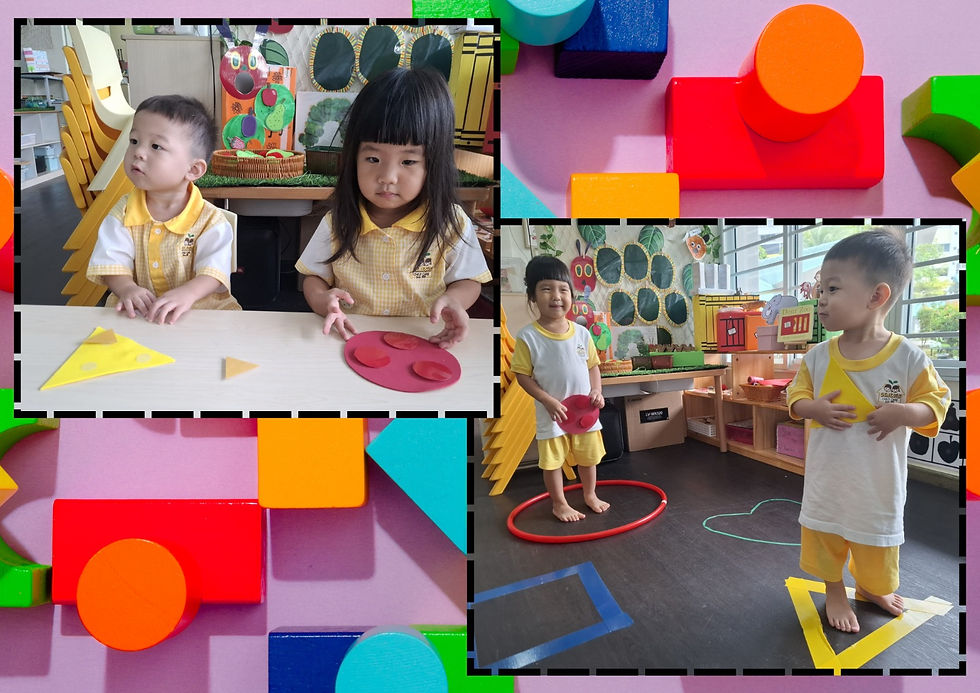
Fun art activities at Tampines child care
It Starts Earlier Than You Think
Long before a child is old enough for preschool, repetition is already at work. A baby who drops a rattle, watches it fall and wants it handed back is running the first science experiment of their life. A toddler who opens and closes a cupboard door twenty times is learning how things move and how their own hands can make something happen.
By the preschool years, the same drive shows up in bigger ways: the same pretend kitchen game, the same drawing of the family, the same song at bath time. The activity looks the same to us, but the child is usually doing something a little different each time.
What Is Happening Inside Your Child’s Brain?
Think of a path through tall grass. The first walk is slow and tiring. After many walks, the path is clear and easy. Learning works in a similar way. Each time a child repeats an action, the brain strengthens the pathway for it, so the action needs less effort and attention.
That is why children are so determined to repeat things they are in the middle of learning. They are not being stubborn. They are doing the work their brain needs to do.
Six Reasons Your Child Keeps Coming Back to the Same Thing
They are practicing. Stacking, pouring, climbing and scribbling all need practice before they feel smooth.
They are checking the rules. “Does the ball always roll down? Does Mummy always come back after peekaboo?” Repeating a game confirms that the world is dependable.
They love being in charge. Young children have little say over their day. Choosing the same activity is one of the few things they fully control.
They are collecting words. A song or rhyme heard many times gives children easy, enjoyable practice with rhythm, sounds and vocabulary.
They are settling their feelings. After a busy or unsettling day, a familiar game can calm a child more quickly than anything new.
They are enjoying success. The pleasure of “I did it!” is worth repeating, and it builds confidence.
Same Activity, Different Child
Repetition looks different at each stage:
Age | What you may see | What it often means |
Babies (6 to 12 months) | Dropping objects, repeated peekaboo, banging and shaking | Learning cause and effect, and that you will always come back |
Toddlers (1 to 3 years) | Opening and closing doors, filling and emptying containers, the same song on loop | Exploring movement and space, building language, wanting control |
Preschoolers (3 to 6 years) | The same pretend game, the same drawing, endless “why” questions | Rehearsing real life, building memory, working through feelings |
Myths and Facts
Myth: My child is not learning anything new.
Fact: The activity may look unchanged, but the child is often adding small details, speed or understanding each time.
Myth: I should stop it so my child does not get stuck.
Fact: Children usually move on naturally once they feel they have mastered something.
Myth: Only boring tasks are repeated.
Fact: Children repeat what challenges and delights them, which is exactly the point.
Try This Week: Small Ways to Join In
Be the audience. Watch and say what you see: “You poured it all the way to the top!”
Change one thing. Same game, but add a new toy, a new word or a slower pace.
Narrate and name. Put words to your child’s actions to build vocabulary.
Protect the favorites. A favorite blanket, book or song before nap time is a comfort, not a bad habit.
Give warnings, not surprises. For example, “Two more turns, then lunch,” helps children handle the end of a loved activity.
How Caregivers Support Repetition at an Infant and Child Care Centre
In a nurturing care setting, repetition is welcomed. Caregivers keep daily routines predictable, keep familiar toys and activities within reach, and offer gentle variations as children show they are ready. A child who returns to the same activity is telling the adults around them what they are working on, and good caregivers listen.
At Nurture Infant House, we see each repeated activity as a clue to what a child needs next.
When to Ask for Advice
Repetition is part of normal development.
Consider talking with your child’s caregiver or doctor if you notice that your child:
Repeats the same action in the same rigid way and rarely plays any other way
Becomes very upset when the activity is interrupted or changed
Seems to have little interest in people, or limited eye contact or babbling or speech for their age
Finds eating, sleeping or daily routines hard because of repetitive behavior
A conversation does not mean something is wrong. It simply gives your child the chance for early support if they need it.
Questions Parents Often Ask
Why does my toddler throw things on the floor again and again? This is usually a test of cause and effect. They are learning that actions have results and that you will respond.
Is it a problem if my child only wants one toy? Usually not. Offer other toys beside it without removing the favorite, and let curiosity grow at your child’s pace.
How many times is “too many” times? There is no set number. What matters more is whether your child is enjoying it, can still move on with support and is also playing in other ways.
Should I get tired of the same song or just let it play? Let it play when you can. Repetition builds language, and your child is likely to move to a new favorite before long.
When do children grow out of this? They do not so much grow out of it as grow into new things to repeat. Repetition continues, in more complex forms, throughout childhood.
Thinking About Care for Your Little One?
Every child learns at their own pace, and the best care follows that pace with warmth, patience and attention. If you would like to see how Nurture Infant House cares for babies and young children, we would be happy to welcome you for a visit and answer your questions.
Remember
Repeating is how young children learn and feel safe.
The same activity is rarely exactly the same for the child.
Join in, add small changes and keep routines steady.
Seek advice if repetition is rigid, distressing or limits other play and development.
Nurture Infant House (2 to 18 months Infants)
Blk 433 Tampines Street 43 #01-61 S(520433) - Since 2011